
Privacy-Compliant Guest WiFi: Collecting Customer Data Without Collecting Legal Problems
Guest WiFi data capture sits at an awkward intersection: it's one of the most effective marketing tools a physical business can deploy, and it's also,…
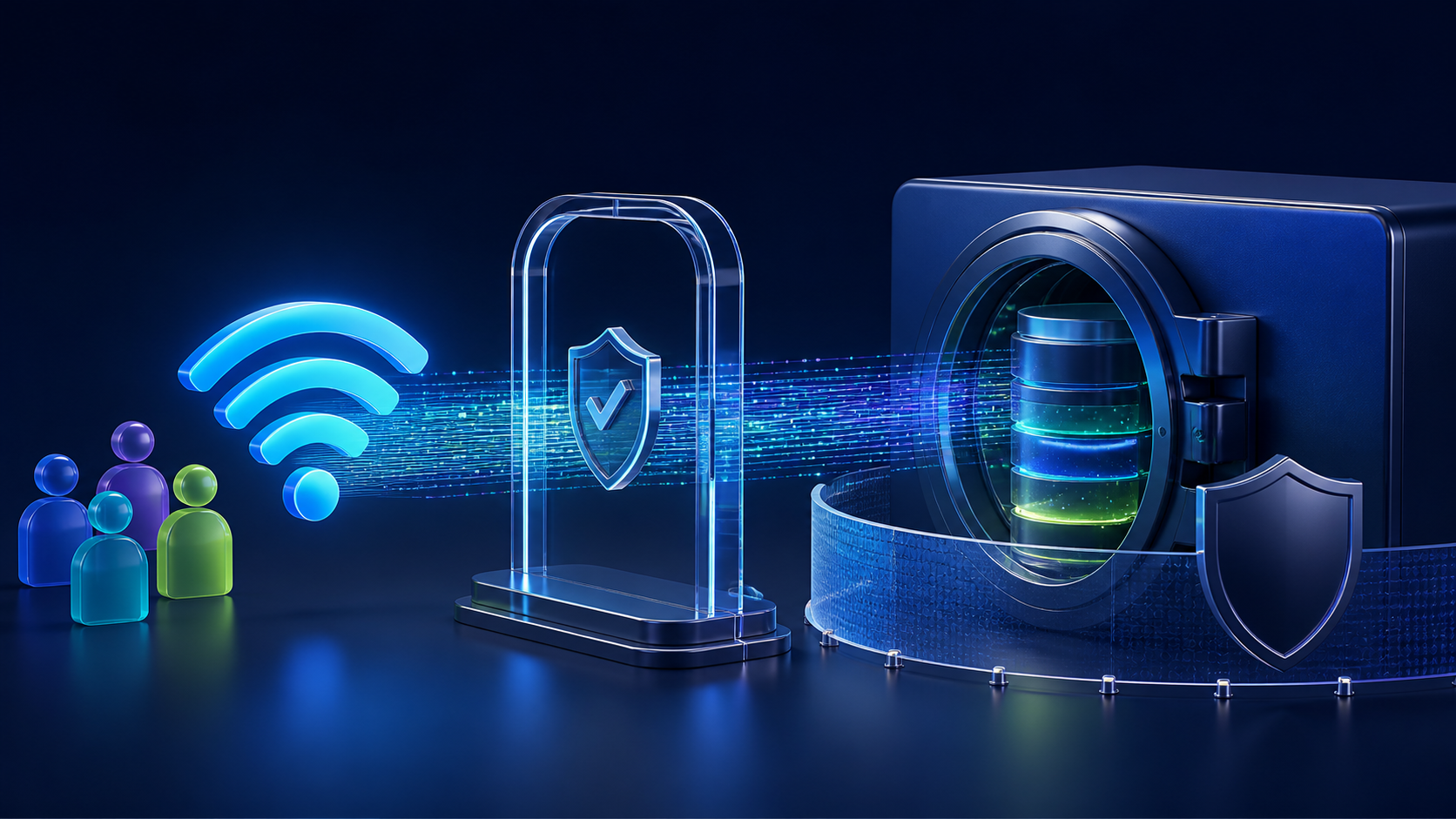
Guest WiFi data capture sits at an awkward intersection: it's one of the most effective marketing tools a physical business can deploy, and it's also, unavoidably, personal data collection. Do it thoughtfully and you build a valuable, fully legitimate marketing asset. Do it carelessly and you've built a liability database with your company's name on it.
The rules aren't as scary as they sound, but they are real. Here's a plain-English guide to privacy-compliant guest WiFi — what the major frameworks expect, the practices that satisfy them, and how NerdPortal bakes compliance into the portal layer on UniFi networks. (One disclaimer up front: this is practical guidance, not legal advice — for your specific obligations, talk to your attorney.)
Why Privacy Law Applies to Your Splash Page
When a guest types an email address into your captive portal, you become a collector of personal data. Depending on where you operate and who your guests are, several frameworks can apply:
GDPR (EU/EEA guests). The strictest and most influential framework. If European visitors connect to your WiFi — think hotels, airports, tourist-district businesses — GDPR principles apply to their data: lawful basis for collection, transparency, purpose limitation, data minimization, retention limits, security, and honoring rights like access and deletion.
U.S. state privacy laws. California's CCPA/CPRA led the way, and a growing roster of states — Virginia, Colorado, Texas, Florida among them — now have comprehensive privacy statutes. Thresholds vary, but the direction is uniform: disclose what you collect, why, and give consumers rights over it.
CAN-SPAM and CASL. The moment you email your captured list, U.S. CAN-SPAM rules (honest headers, identification, working unsubscribe) and — for Canadian recipients — CASL's consent requirements govern the messages.
PCI DSS, adjacent but important. Not a privacy law, but if you take cards, the payment security standard expects guest networks to be segmented from cardholder systems. Compliant data collection on a non-compliant network architecture is only half a solution.
The pattern across every framework is identical: tell people what you're doing, collect only what you need, protect it, don't keep it forever, and honor requests about it. That's not just achievable at the WiFi layer — it's easy, if your portal platform was designed for it.
The Seven Practices of Compliant WiFi Capture
1. Disclose at the point of collection. Your splash page should say, in normal human language, what you collect and why: "We'll use your email to send occasional offers and updates." Link your full privacy policy from the portal. Burying the disclosure is the single most common (and most avoidable) failure.
2. Get affirmative acceptance. Guests should actively accept your terms before connecting — a required checkbox, not a pre-ticked one or a buried implication. NerdPortal enforces terms acceptance as part of the connection flow, so acceptance is consistent and recorded, not dependent on page design luck.
3. Minimize what you ask for. Data minimization is both a legal principle and good conversion practice. An email address serves nearly every marketing purpose; add a phone number or one custom field only if you'll genuinely use it. Every unnecessary field is extra liability and extra signup friction — compliance and conversion agree here.
4. Limit retention — automatically. "We keep everything forever" is the posture regulators dislike most, and it's also the default of any homegrown solution. NerdPortal applies automatic data retention policies by plan and configuration — 30 days on Starter, 90 on Pro, one year on Enterprise — so old records purge on schedule without anyone remembering to do it. Retention limits enforced by software beat retention policies written in a binder.
5. Secure it in transit and at rest. Captured data should be encrypted end to end. NerdPortal uses AES-256-GCM encryption of stored credentials and privacy-conscious handling throughout, and because guests connect through the portal rather than a shared password, there's no communal credential floating around your building either.
6. Honor unsubscribes and deletion requests. Every marketing email needs a working unsubscribe, and your process should be able to delete a guest's record on request. Keeping your list in an exportable, well-structured system (CSV/JSON export, API sync to your CRM) makes fulfilling these requests a lookup, not an archaeology project.
7. Segment the network underneath. Privacy-compliant collection on top of a flat network that exposes your POS to guest traffic is a mismatched outfit. Guest VLANs with deny-by-default firewall rules are the infrastructure half of compliance; The UniFi Nerds design and validate exactly this architecture on UniFi networks nationwide.
What This Looks Like in NerdPortal, Concretely
On a UniFi network (Network application 7.0+, including 8.0+), NerdPortal turns the checklist above into configuration rather than a project:
- Branded portal with your disclosure language and linked privacy policy — edited point-and-click, deployed instantly to every location.
- Mandatory terms acceptance before network authorization, uniformly enforced.
- Configurable fields so you collect exactly what you decided to collect and nothing more.
- Automatic retention purging records on your schedule.
- Encrypted storage and transfer of every submission.
- Structured export and API access so access, correction, and deletion requests are quick to fulfill and your email platform always works from clean, sourced, consented data.
- Centralized multi-site policy, so location #9 isn't quietly running last year's terms. One policy, every site, one dashboard.
That last point deserves emphasis for chains and franchises: fragmented guest WiFi is where compliance dies, because nobody can even state what the current practice is. Centralizing the portal layer makes your posture describable in one sentence — which is precisely what you want if anyone ever asks.
Compliance Is a Trust Feature, Not a Tax
Here's the reframe worth internalizing: guests are increasingly privacy-aware, and a portal that plainly says what it collects, asks for little, and delivers instant WiFi feels more professional than a sketchy form or a chalkboard password. Transparent collection converts better than sneaky collection. The same design choices that satisfy a regulator reassure a customer — you're not paying a compliance tax, you're buying trust at the moment of first contact.
Frequently Asked Questions
Does GDPR really apply to my U.S. business? If EU residents' data ends up in your systems — common in hospitality and tourism — GDPR principles can reach you. Building to the GDPR standard also future-proofs you against the state laws converging on similar rules.
Can guests decline data collection and still connect? That's your policy choice. Many businesses treat the email exchange as the access condition with clear disclosure; others offer a limited no-data option. NerdPortal supports the flow you choose.
Who is responsible for the privacy policy text? You (with your attorney). NerdPortal gives you the enforcement mechanism — disclosure placement, required acceptance, retention automation — but the policy language is yours.
What should I do about data we collected before having a policy? Treat legacy data conservatively: if you can't establish how it was gathered or what guests were told, the safest path is to purge it and rebuild through the compliant portal flow. Lists rebuilt through disclosed, terms-accepted capture are cleaner legally and perform better practically — engagement rates on properly consented contacts consistently beat gray-area lists.
Collect Confidently
Guest WiFi data capture done right is a compliance non-event and a marketing advantage. Start a free 14-day NerdPortal trial and put disclosure, consent, encryption, and retention on autopilot — and if the network underneath needs proper guest segmentation, The UniFi Nerds handle that coast to coast.
NerdPortal is built by The UniFi Nerds, the nation's leading UniFi installation and managed services company.